


How to Choose the Right Fast Charger for Your Smartphone
A practical guide to charger wattage, USB Power Delivery, cable compatibility and choosing the right setup for your phone.
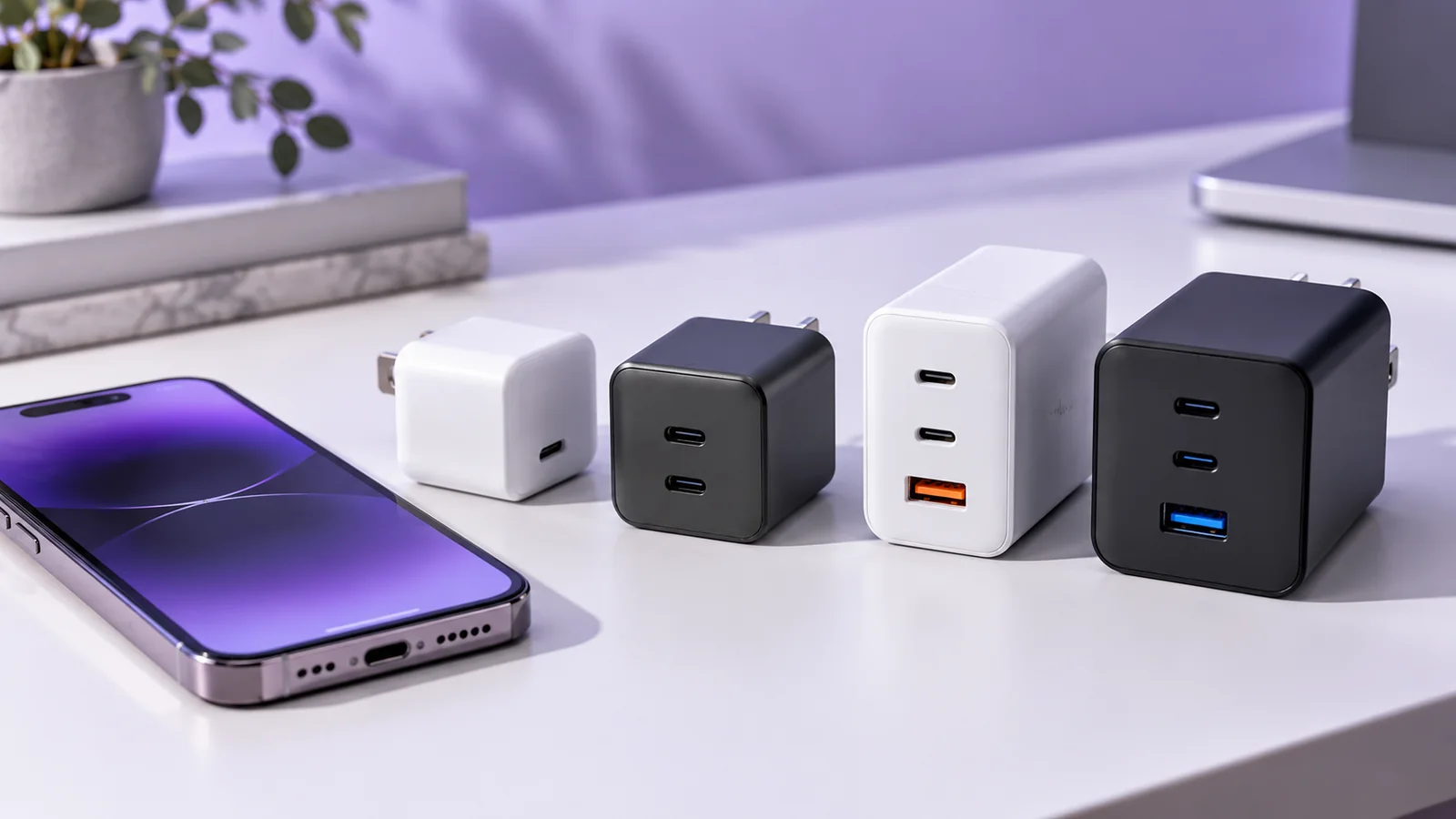
Your smartphone is probably one of the devices you rely on most throughout the day. Whether you're working, travelling, attending meetings or simply staying connected, running out of battery can quickly become inconvenient.
That's why fast chargers have become increasingly popular. But choosing a charger isn't simply about picking the one with the highest wattage printed on the box.
A 20W, 25W, 45W or 65W charger can all be useful depending on the device, charging technology, cable and your actual requirements.
So, how do you choose the right fast charger for your smartphone?
Let's break it down.
What Is Fast Charging?
Fast charging refers to charging technologies that allow a compatible device to receive power more quickly than traditional low-power charging methods.
The amount of electrical power a charger can provide is generally expressed in watts (W).
For example:
20W charger
25W charger
45W charger
65W charger
100W charger
However, a higher wattage does not automatically mean your smartphone will charge at that wattage.
Your phone has its own maximum charging capability and controls how much power it accepts. The charger essentially provides the available power, while the device determines what it can use.
USB Power Delivery (USB PD), for example, allows compatible chargers and devices to negotiate power requirements rather than simply delivering a fixed amount of power.
1. Check Your Smartphone's Maximum Charging Power
The first thing to check before buying a fast charger is your smartphone's supported charging power.
Different smartphones support different charging capabilities.
For example, one phone may support around 20W, while another may support 30W, 45W or more.
If your phone supports a maximum of 25W, buying a 65W charger doesn't automatically make the phone charge at 65W. The phone will generally limit the power it draws according to its charging system.
This is one of the most important things to understand when choosing a fast charger.
The simple rule:
Check your phone's charging specification before choosing the charger.
2. Understand Charger Wattage
Wattage tells you the maximum power output a charger is designed to provide under its supported conditions.
You may commonly come across chargers such as:
These aren't universal charging-speed categories. The actual result depends on the device and charging standard.
A 65W charger, for example, can be useful even if your phone doesn't require 65W because the extra capacity can make the charger more versatile for compatible devices.
Modern chargers can also support different power levels depending on what the connected device requests.
3. Don't Choose a Charger Based Only on Wattage
This is one of the most common mistakes when buying a fast charger.
A charger marked 65W isn't necessarily the best charger for every smartphone.
Charging performance can depend on:
Smartphone charging limit
Charging protocol
Charger output
Cable capability
Connector type
Battery level
Temperature
Whether multiple devices are connected
Modern smartphones can adjust charging power during the charging cycle. Charging may be faster at lower battery levels and gradually reduce as the battery gets closer to full.
So, think of wattage as one part of the equation, not the entire equation.
4. Understand USB-C and Power Delivery
USB-C has become increasingly important in modern charging.
One reason is its compatibility with USB Power Delivery (USB PD), a charging technology that enables flexible power delivery between compatible devices and chargers.
USB-IF explains that USB PD allows devices to negotiate power requirements and supports higher power levels through compatible USB-C implementations.
This makes USB-C PD particularly useful for people who want a charger that can work across multiple devices.
For example, a compatible charger may be used for:
Smartphone
Tablet
Wireless accessories
Portable devices
Some laptops
The actual power available still depends on the charger, cable and connected device.
5. Why the Cable Matters
Buying a high-wattage charger but pairing it with an unsuitable cable can limit the charging setup.
The cable is part of the charging chain.
For example, if you have a high-output USB-C charger but the cable isn't appropriate for the required power or charging standard, you may not get the performance you expect.
When choosing a fast-charging setup, consider:
Charger + Cable + Device
All three should be compatible with the charging requirements.
This is particularly important when using higher-power chargers.
6. 20W vs 25W vs 45W vs 65W: Which One Should You Choose?
There isn't one wattage that is universally right for every smartphone.
Instead, consider your usage.
20W Charger
A 20W charger can be a practical choice for everyday smartphone charging when the device supports that level.
It's also useful when compactness and basic fast charging are priorities.
25W Charger
A 25W charger can be suitable for smartphones that support charging around this level.
It's a useful middle ground for users who want fast charging without necessarily moving into higher-power charging.
45W Charger
A 45W charger can make sense for compatible smartphones that support higher charging power.
It can also provide additional versatility if you use other compatible devices.
65W Charger
A 65W charger offers substantially more available power and can be useful when you want one charger capable of supporting smartphones and other compatible devices.
However, a phone that only supports a lower charging input won't automatically charge at 65W.
7. When Does a Higher-Wattage Charger Make Sense?
A higher-wattage charger can be useful when:
Your smartphone supports higher charging power
You want one charger for multiple compatible devices
You also charge a tablet
You need additional power capacity
You regularly charge more than one type of device
But if you only need to charge a smartphone that supports a lower power level, you may not need the highest-wattage charger available.
More watts isn't always better. The right watts are better.
8. Consider the Number of Ports
If you regularly charge multiple devices, consider how many ports you need.
A single-port charger can be ideal when you're primarily charging one smartphone.
A multi-port charger can be more convenient if you regularly charge:
Smartphone
Earbuds
Smartwatch
Tablet
Other USB-powered devices
However, remember that a multi-port charger's total output may be distributed between connected devices.
So don't look only at the headline wattage. Check the output specifications for individual ports and combined usage.
9. Look at Charging Protocol Compatibility
Fast charging isn't controlled by wattage alone.
Different devices can use different charging technologies and protocols.
USB Power Delivery is one widely used standard, while some manufacturers also use proprietary charging technologies.
A charger can therefore have a high wattage rating but still fail to provide a device's maximum charging speed if the necessary charging protocol isn't supported.
Before purchasing, check:
Your phone's supported charging standard
The charger's supported protocol
Maximum output
Connector type
Cable requirements
This can prevent you from paying for capabilities your device can't actually use.
10. Is a Higher-Wattage Charger Safe for Your Phone?
A common concern is whether using a charger with a higher maximum output can damage a smartphone.
A compatible modern charging system is designed so that the device manages the power it accepts rather than simply receiving the charger's maximum advertised output.
USB Power Delivery, for example, is designed around power negotiation between compatible devices and chargers.
However, compatibility and product quality still matter.
When choosing a charger, look for:
Clear power specifications
Proper charging-standard support
Appropriate cable compatibility
Reliable product construction
Relevant safety and compliance information
A reputable brand or supplier
Avoid choosing a charger solely because it has the largest wattage number.
11. Common Fast-Charger Buying Mistakes
Mistake 1: Choosing the highest wattage
A 100W charger isn't automatically better for a phone that only supports a much lower input.
Mistake 2: Ignoring the cable
The charger and cable should be considered together.
Mistake 3: Ignoring charging protocols
A charger needs to support the relevant standard for your device to achieve its intended charging performance.
Mistake 4: Looking only at price
An extremely low-priced charger may not provide the quality, specifications or reliability you expect.
Mistake 5: Assuming every USB-C charger is the same
USB-C describes the connector, not a guarantee of identical charging performance. Different chargers and cables can support different power and data capabilities.
12. How to Choose the Right Fast Charger
Before purchasing, use this simple checklist:
Step 1 — Check your smartphone
Find out its maximum supported charging power.
Step 2 — Check the charging standard
Look for USB PD or the charging technology supported by your device.
Step 3 — Choose appropriate wattage
Select a charger that meets your phone's requirements and your broader usage needs.
Step 4 — Check the connector
Make sure the charger and cable match your device.
Step 5 — Choose the right cable
Make sure the cable supports the power requirements of your charging setup.
Step 6 — Consider your other devices
If you charge a tablet or other compatible devices, a higher-wattage charger may provide more flexibility.
Step 7 — Consider quality
Look for clear specifications, reliable construction and a trustworthy brand.
DZIVE Fast-Charging Solutions
A Range Built Around Different Charging Requirements
DZIVE's product catalogue includes a broad selection of charging solutions, with charger models listed across different power specifications including 20W, 25W, 45W, 65W, 67W, 100W and 120W, along with different charger configurations.
This range allows businesses to explore charging products suited to different device requirements and market segments.
For distributors, wholesalers and other business buyers looking for a broader mobile accessories portfolio, DZIVE combines a wide product selection with competitive value and pan-India availability.
Explore the DZIVE charger range to find the products suited to your requirements.
Final Thoughts
Choosing the right fast charger isn't about finding the charger with the biggest number on the box.
It's about finding the right combination of:
Wattage + Compatibility + Charging Standard + Cable + Quality
Start with your smartphone's specifications, understand what it actually supports, and then choose a charger that fits both your device and your everyday requirements.
A well-matched charging setup can make everyday charging faster, more convenient and more versatile—without paying for capabilities you don't actually need.
Explore the DZIVE range
Compare products across charging, power, audio and connectivity, or contact our team with your requirement.